Wednesday, May 26, 2021

Q&A with Celia Jeffries, Author of Blue Desert -- AUTHOR INTERVIEW


AUTHOR INTERVIEW: CELIA JEFFRIES

In her new novel, Blue Desert, author Celia Jeffries weaves an exciting tale of a young British woman living -- and loving -- among the Taureg nomads of the Sahara in the early 1900s. The story unfolds as Alice tells it to her husband decades later, after she receives a startling telegram.


Celia talked with Rose City Reader about Blue Desert, Tuareg culture, favorite authors, and more:

How did you come to write Blue Desert?

Blue Desert began as the voice of an older woman looking back at her life. That "voice" kept appearing on the page now and then as I was writing other pieces, and finally I decided to listen to it, to see where it might take me. The name Alice was clear to me, and the fact that she had a story she had never told anyone was also clear. The rest was discovery.

The main story takes place in the Tuareg society of the Sahara in the early 1900s. What drew you to this setting for your novel?

When you let a character lead the way, you never know where you might end up! I was familiar with Edwardian British society from my love of 19th century/early 20th century writers, but when Alice headed into the Sahara I was a bit clueless. During a writing workshop I read a piece I had just written and a French woman turned to me. “You’re writing about the Blue Men,” she said. Who were the Blue Men? The Tuareg. The French are much more familiar with them, having colonized Algeria and parts of the Sahara.

How did you research the historical information and detail found in your book?

I read everything I could find about the Sahara and the Tuareg—literature; history; geographical and anthropological overviews; the art, music, and jewelry of the Tuareg. And I watched films made in Morocco and the Sahara. After a couple of drafts of the novel I joined an "adventure tour" to Morocco that traveled throughout the country and made a five-day trek on camel into the Sahara.

Did you know right away, or have an idea, how you were going to end the story? Or did it come to you as you were in the process of writing?

I didn’t know how the book would end, and worked on a number of different endings, none of which were particularly satisfying. Once Martin’s character appeared, the ending came into focus. I knew where the story would land in terms of time and place, but the words were more difficult. I rewrote the final page so many times—even as we were going to press!

What did you learn from writing your book – either about the subject of the book or the writing process – that most surprised you?

I became fascinated by the Tuareg society, and the history of the Sahara. Here was a land mass larger than the continental United States that seemed completely hostile to human life. And here was this tribe that had found a way to live in harmony with that environment. Add to that, in contrast to most civilizations I knew, women were valued and held power within their society.

The story demanded that I write about parts of our human character that we often tamp down, excuse, or avoid: violence, greed, sexuality, etc. Just as we all have those impulses within us and we all have to manage them, I had to allow my characters to deal with their own impulses.

What themes do you hope readers will find in your novel?

For me, one of the themes in Blue Desert, what writing it confirmed for me, is that survival and love can take many forms. What helped Alice survive in the desert was acceptance—of her situation, of the people she found herself among. What helped Martin survive the war was acceptance of the altered state of the world. And what made their marriage work was total acceptance of each other.

What do you hope readers will take away from your book?

I have been fascinated by readers’ responses—so many time readers have found things in the novel that surprise me, and quite frankly humble me. When you create something—a book, a painting, a piece of music—you are tapping into a consciousness larger than your own. I love books that open up the world in a new way and help us understand the human condition. I hope Blue Desert provides a bit of that experience for its readers.

What is your favorite review or compliment you received about your book?

Many readers say Blue Desert should be a movie. What that says to me is that they could “see” the story, that the characters and settings came alive in a certain visual way, which is a great compliment.

What is your background and how did it lead to writing fiction?

I think I was born reading and writing; it feels like breathing to me (and means I have way too many books and notebooks floating about the house). After earning an MA in English and American literature, I worked in education, journalism, and publishing. All of that came together when I returned for an MFA in fiction and creative nonfiction. Journalism taught me to always ask “what is the story?” and to try to tell it as clearly and succinctly as possible. Reading and studying great writers from many different cultures allows the cadence of language to seep into your writing.

Were books an important part of your household when you were growing up?

There were whole shelves of Readers Digest Condensed books in the house I grew up in. It makes me cringe now to think of "condensing" good writing, but what it meant was that I read widely and way beyond my own childhood understanding. I also sneaked peeks at the illustrated Edgar Allen Poe that my mother had hidden because it was too scary for children, and I found my father’s Modern Library college editions of the classics, some of which I still have.

Who are your three (or four or five) favorite authors? Is your own writing influenced by the authors you read?

This is the most difficult question of this Q&A! When I think of an answer I can see that I have moved through many phases of writers. Tolstoy will always stand out for me, even though I turned away from the white male canon for a while. I think my writing is influenced by everything I’ve ever read or experienced. While writing Blue Desert I found myself in awe of Michael Ondaatje’s The English Patient and Anthony Doer’s All the Light We Cannot See, both of which deal with lives braided together by the cataclysm of war. When I wrote this last sentence I realized that was, of course, what Tolstoy also wrote about…

What are you reading now?

My current stack of books includes Tove Ditlevson’s The Copenhagen Trilogy, George Saunders A Swim in the Pond in the Rain, Flaubert’s Madame Bovary and Francisco Goldman’s Monkey Boy. (That’s just the top of the stack.)

You have a terrific website and are also active on Facebook and Instagram. From an author’s perspective, how important are social networking sites and other internet resources?

I have to confess to being a reluctant social media person who is now a believer. The world is full of readers and the internet is one of the best ways to connect people to books, with surprising results. My favorite surprise was a woman from Tokyo who follows my Instagram. Why? Because she has a beautiful shop and sells Tuareg jewelry!

What advice has helped you the most as a writer?

Be wild in writing and ruthless in revision.

Do you have any events coming up to promote your book?

I have a number of private book group readings [in person and virtually] at the moment and am doing a radio interview that will be broadcast later in the summer. Book groups are welcome to check my website if they’d like to set up a private reading. Also check my website for the radio broadcast and other upcoming events.

Are you working on another book?

I am working on a memoir that has been coming together piece by piece, a few pieces of which have been published in literary magazines and online.


THANK YOU, CELIA!

BLUE DESERT IS AVAILABLE ONLINE IN PAPERBACK OR E-BOOK.


Monday, May 24, 2021

New in Blue -- Five Great Books for MAILBOX MONDAY


MAILBOX MONDAY

In a moment of social media serendipity, as I gathered these books on my desk to start my Mailbox Monday post, a friend tagged me on Instagram for a #bluestackchallenge. I didn't know that was a thing and, at that very moment, I was doing it. Crazy!

What new books came into your house last week? Or lately? I haven't done a Mailbox Monday post in a few weeks. In the meantime, these books have drifted my way. 


The Mediterranean Wall by Haitian author Louis-Philippe Dalembert, translated from French by Marjolijn de Jager, launches June 15 from Shaffner Press and is available for pre-order

This rich and compelling novel tells the story of three women fleeing their homelands -- Nigeria, Somalia, and Syria. They are thrown together aboard a dilapidated refugee boat in the Mediterranean Sea, trying to get to Europe. 


Shoal Water by Kip Robinson Greenthal won the 2020 Landmark Prize for fiction. The prize is publication by Homebound Publications, although I didn't realize that it is not coming out until this fall. I jumped the gun a bit. You can pre-order now

Shoal Water is the story of Kate and her husband who move from New York City to a fishing village in Nova Scotia and open a book store. Navigating the new community is trickier than imagined and Kate must confront ghosts of the past -- metaphorical and literal -- in this beautiful debut novel.


Spin: A Novel Based on a (Mostly) True Story by Peter Zheutlin, comes out next week from Pegasus Books.

In the 1890s, Annie Londonderry became "the first woman to cycle around the world" and a newspaper sensation. Spin is the historical fiction account of her adventures, written by author Peter Zheutlin, who is also her great-grand-nephew. Spin is a fun summer read for adult and YA fans of historic fiction.


Life in a Cold Climate: Nancy Mitford; The Biography by Laura Thompson (2019, Pegasus Books). 

This one isn't new, but it's new to me. I love Nancy Mitford's novels and, like so many others, am fascinated by the Mitford sisters. I can't wait to read this biography and learn more!


The Dive: The Untold Story of the World's Deepest Submarine Rescue by Stephen McGinty. The subtitle really says it all. This is the true story of the race to save two men trapped in a broken submarine on the ocean floor. I admit it is not a book for me. But I swear my husband could SMELL IT in the house. The man who cannot find a 22-pound turkey in the refrigerator found this one book in a stack of books in a house with thousands of books. He's so excited!

Judging by how fast my husband tore The Dive from my hands, I'd say it's a good bet for Father's Day (June 20). It launches June 8, so if you pre-order it will get here in plenty of time.


Join other book lovers on Mailbox Monday to share the books that came into your house last week. Visit the Mailbox Monday website to find links to all the participants' posts and read more about Books that Caught our Eye.

Mailbox Monday is hosted by Serena of Savvy Verse & Wit and Martha of Reviews by Martha's Bookshelf. They are looking for a third host. If you are interested, check out the Mailbox Monday website for details. 


Thursday, May 20, 2021

No Modernism Without Lesbians by Diana Souhami, from Head of Zeus Books - BOOK BEGINNINGS


BOOK BEGINNINGS ON FRIDAYS

I had such a fantastic week! My mom and sis and I spent four days at the Oregon coast on our first post-vaccine road trip and we had so much fun! I haven't been away from home overnight for 15 months so it felt very weird to be out of my house. But we rented an AirBnB house, the weather was lovely and the beach all but deserted, we ate delicious food, and I had a great new mystery book to read. I quickly remembered how much fun it is to go on vacation!

And now I am back and it is time again for Book Beginnings on Fridays, where book lovers share the opening sentence (or so) of the book they want to feature. Please share the link to your Book Beginning blog or social media post in the Linky box below. If you share on SM, please use the hashtag #BookBeginnings.

MY BOOK BEGINNING

In the decades before the Second World War, many creative women who loved women fled the repressions and expectations of their home towns, such as Washington and London, and formed a like-minded community in Paris.  
Dianna Souhami's new history of 1920s Paris focusses on four women -- Sylvia Beach, Bryher, Natalie Barney, and Gertrude Stein -- who were at the center of the Modernist movement. I love the brash title!

Beach started the Shakespeare and Company bookstore and published James Joyce's Ulysses. Bryher was a novelist, magazine editor, and heiress who used her fortune to help struggling writers. Barney was a writer and influential salon hostess. Stein was a patron of the arts and avant-garde author.


Mister Linky's Magical Widgets -- Thumb-Linky widget will appear right here!
This preview will disappear when the widget is displayed on your site.
If this widget does not appear, click here to display it.

THE FRIDAY 56

TIE IN: The Friday 56 hosted by Freda's Voice is a natural tie in with this event and there is a lot of cross over, so many people combine the two. The idea is to post a teaser from page 56 of the book you are reading and share a link to your post. Find details and the Linky for your Friday 56 post on Freda’s Voice.

MY FRIDAY 56

From No Modernism without Lesbians:
Moeller tried to explain the Freudian subconscious mind so as to help the court realize the intellectual underpinning of Ulysses. The judge asked him to speak in a language the court could understand.
-- Describing the obscenity trial following the original publication of Ulysses


Thursday, May 13, 2021

The Garden in Every Season: A Year of Insights and Inspiration from My Garden by Tovah Martin -- BOOK BEGINNINGS

cover of The Garden in Every Season: A Year of Insights and Inspiration from My Garden by Tovah Martin

 BOOK BEGINNINGS ON FRIDAYS

Where did this week go? I wanted to get a couple of other posts up between last week's Book Beginnings post and this one, but here it is, time to post another Book Beginning and nothing new on the blog since then. Some weeks are like that! Life gets in the way of hobbies. 

So thank you for joining me once again for Book Beginnings on Fridays, where bibliophiles gather to share the first sentence (or so) of the book they want to highlight this week. Please add the link to your Book Beginning blog or social media post in the Linky box below. 

MY BOOK BEGINNING

This is the story of a nose and how I followed it through the year. This is the saga of a garden and how it spoke to me. In these pages I chronicle a pair of hands as they grope their way through the weeding, hoeing, and digging without too much pain. And this is the tale of someone who has looked at her garden for years, but only now saw it fully for the first time.

-- From the Introduction, "Coming to My Senses," in The Garden in Every Season: A Year of Insights and Inspiration from My Garden by Tovah Martin, new from Timber Press

I don't usually give such a long opening, but I want you to get a better idea of the book. In it, Martin chronicles four seasons in her garden, carefully describing what each of her five senses experiences each season. 

Tovah Martin has been creating her seven acre garden in northeastern Connecticut since 1996, so there is plenty for her to see, smell, hear, touch, and taste. The 100 essays in her book will make garden-lovers appreciate their own landscapes in new ways.


YOUR BOOK BEGINNINGS

Please add the link to your Book Beginning post here. If you post or link to social media, please use the #bookbeginnings hashtag.

Mister Linky's Magical Widgets -- Thumb-Linky widget will appear right here!
This preview will disappear when the widget is displayed on your site.
If this widget does not appear, click here to display it.


THE FRIDAY 56

Freda at Freda's Voice hosts another teaser event on Fridays. Participants share a two-sentence teaser from page 56 of the book they are reading -- or from 56% of the way through the audiobook or ebook. Please visit Freda's Voice for details and to leave a link to your post.

MY FRIDAY 56

There is no such thing as instant gratification with asparagus. After digging your trench, nestling the roots in, and shoveling the good earth on top, you have to wait a few years before the feast.

I have no sun in my shady yard for any kind of vegetable garden. But this book makes me appreciate my vegetable-growing friends and their generosity all the more!


Thursday, May 6, 2021

The Bridgetown Sonata: Sonata Mulattica by Emmanuel Dongala -- BOOK BEGINNINGS


cover of The Bridgetown Sonata: Sonata Mulattica by Emmanuel Dongala

BOOK BEGINNINGS ON FRIDAYS

After a whirlwind couple of weeks at work, I can finally catch my breath! Thank heavens! Which means I remembered to put up this Book Beginnings post on time, Thursday evening, for people who like to post early. I've been forgetting to do that -- sorry! 

You do not have to post early. You can post on Friday. You can even come back and add a post any time during the week. 

Book Beginnings on Fridays is a chance for readers to share the first sentence (or so) of the book they are reading that week. You can also share a book you are excited about, even if you aren't reading it right now. 

Please add the link to your Book Beginning blog or social media post in the Linky box below. If you post or share on SM, please use the hashtag #bookbeginnigns. 

MY BOOK BEGINNING

From The Bridgetown Sonata: Sonata Mulattica by Emmanuel Dongala, translated by Marjolijn de Jager (2021, Pegasus Books):

Borne by the last arpeggio notes of the final rondo, momentarily suspended above the violin -- the time of an eighth-note rest -- the bow attacked the code of the last movement, the allegro spiritoso, in a dazzling play of shifting and multi-colored cadences whose final very sharp trills were lost in the sound of the full orchestra and the applause of the audience that, having held its breath until then, could no longer restrain itself. 

It is hard to write about music, but that sentence captures the drama of a classical concert. 

George Bridgetower was an 18th Century violin virtuoso and the son of a Black man from the Caribbean. He was a child prodigy who entertained Parisienne high society on the eve of the French Revolution. He then fled to London where he was a court favorite of the Prince of Wales. 

When he moved to Vienna, he became the friend and collaborator of Ludwig Van Beethoven. The two composed the "Sonata Mulattica" together, but Beethoven later changed the name to the "Kreutzer Sonata" when the two had a falling out. 

Emmanuel Dongala's new historical novel brings life to this forgotten story. He makes the most of what is known about Bridgetower's life, telling a fascinating story of race, class, creativity, and friendship in 18th Century Europe.


YOUR BOOK BEGINNINGS 

Please link to your Book Beginnings post in the box below. 


Mister Linky's Magical Widgets -- Thumb-Linky widget will appear right here!

This preview will disappear when the widget is displayed on your site.
If this widget does not appear, click here to display it.


THE FRIDAY 56

Freda at Freda's Voice hosts another teaser event on Fridays. Participants share a two-sentence teaser from page 56 of the book they are reading -- or from 56% of the way through the audiobook or ebook. Please visit Freda's Voice for details and to leave a link to your post.

MY FRIDAY 56

From The Bridgetown Sonata:
That was why he'd put on the fine suit he'd set aside the night before. Furthermore, instead of a sword he was wearing his Turkish Saber at his side.


Tuesday, May 4, 2021

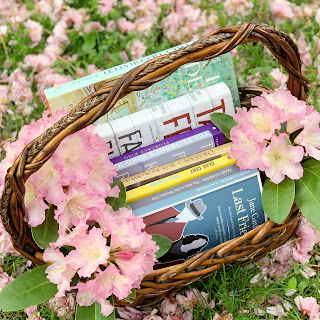
April Wrap Up -- My April Books

basket of books

APRIL WRAP UP

April showers brought these May flowers! And a basket of books I read in April.

I continued to make progress on my TBR 21 in '21 and Mt. TBR Challenges and the Vintage Mystery Challenge. I read one that could count for the European Reading Challenge, although it is not a challenging pick. I am not making much progress on the Back to the Classics Challenge so need to pay more attention to that one in the months ahead.

Here are the 11 books I read in April, in the order I read them, not the order in the picture. There wasn't a dull read in the bunch. 

See any favorites or anything that looks good?

MY APRIL BOOKS

The Man in the Wooden Hat by Jane Gardam. This is the second in her Old Filth trilogy. I read the first, Old Filth, last month. Wonderful books! 🌹🌹🌹🌹🌹

Last Friends  by Jane Gardam, the last book in the trilogy. I am glad I read them straight through to get the most out of the experience. 🌹🌹🌹🌹🌹

Slightly Foxed, No. 60, edited by Gail Pirkis. Hubby got me a subscription for my birthday and this 2018 back issue from eBay so he would have something to wrap. I started by reading it and loved it, of course. I'm counting these as "books" read so I can keep track of which ones I finish. 🌹🌹🌹🌹🌹

Apropos of Nothing, Woody Allen’s new autobiography (not shown because I read it with my ears). I wanted to read this because of all the controversy and am glad I did. He reads the audiobook himself, which I like with nonfiction. It is also really funny. This was a surprising highlight of the month. 🌹🌹🌹🌹

Dead Cert by Dick Francis, his first novel, published in 1962 and showing the hallmarks of his always-satisfying stories. 🌹🌹🌹🌹🌹

Gaudy Night by Dorothy L. Sayers, more vintage mystery. This one a deserved classic. 🌹🌹🌹🌹🌹

Obasan by Joy Kogawa is on the Erica Jong Top 100 20th Century Novels by Women list and has been on my TBR shelf a long time. It is about Japanese Canadians during WWII. I am familiar with the history of interned Japanese Americans during WWII, but knew nothing about what happened to Japanese Canadians living in British Columbia during and after the war. Heartbreaking. It is excellent novel and a moving novel. 🌹🌹🌹🌹

The Wisdom of Father Brown by G. K. Chesterton, vintage mystery short stories. (Free on Kindle, by the way.) 🌹🌹🌹🌹

The Florence King Reader is an introduction to this eccentric, hilarious, impossible to categorize writer. It has samples from all her books. 🌹🌹🌹🌹

Faithful Place by Tana French. I’m slowly making my way through Tana French’s Dublin Murder Squad series. This one is the third in the series and my favorite so far. In general, I enjoy them tremendously but find they all get a bit soft in the middle. This counts as my "Ireland" book for the European Reading Challenge. 

How They Decorated: Inspiration from Great Women of the Twentieth Century by P. Gaye Tapp, Foreword by Charlotte Moss, is another beautiful book published by Rizzoli. This was  part of my project to read all my coffee table books. This one inspired a mantel makeover, which was long overdue. 🌹🌹🌹🌹🌹

What were your favorite April books? Or are you already deep into your May reading?

MOST BEAUTIFUL APRIL COVER

cover of How They Decorated: Inspiration from Great Women of the Twentieth Century by P. Gaye Tapp


Monday, May 3, 2021

A Batch of New Spring Books -- MAILBOX MONDAY


MAILBOX MONDAY

It's been a while since I've done a Mailbox Monday post. Not that books haven't been trickling steadily into my house each week. I just haven't had my act together. I do love Mailbox Monday! I need to get myself more organized about posting. 

I gave myself a little Monday motivation by creating a new Mailbox Monday picture. It isn't much to sneeze at, so I think I'll keep puttering. But it will do for now. 

On with it! What books came into your house last week? These five new nonfiction books came my way and I am excited about all of them for different reasons:

cover of The Garden in Every Sense and Season: A Year of Insights and Inspiration from My Garden by Tovah Martin


The Garden in Every Sense and Season: A Year of Insights and Inspiration from My Garden by Tovah Martin is new from Timber Press

What a great idea for a garden book! Tovah Martin describes a year in her garden broken down by season, starting with Spring, and by what is going on for each of the five senses: sight, smell, sound, touch, taste. It really gets you thinking -- and feeling -- about your garden on many levels. 

This one could be a good idea for Mother's Day!

cover if The Age of Decadence: A History of Britain: 1880-1914 by Simon Heffer


The Age of Decadence: A History of Britain: 1880-1914 by Simon Heffer is new from Pegasus Books. 

There was a lot going on in Britain in the late Victorian and early Edwardian periods leading up to the First World War. Simon Heffer dives deep into this fascinating period in his new 900+ page history.

The way my husband snatched this up as soon as he saw it tells me this one may be a good idea for Father's Day.

cover of No Modernism Without Lesbians by Diana Souhami

No Modernism Without Lesbians by Diana Souhami is new from Head of Zeus

This is the story of how four women -- Sylvia Beach, Bryher, Natalie Barney, and Gertrude Stein -- fostered the Modernist movement in Paris in the 1920s. Yes, I wanted to read it because I love the brash title!


This is Emerick's memoir about moving to the Alaskan coast when she was 38, becoming a kayak ranger, and trying to stay married to a man from another island. 

cover of On the Run: Finding the Trail Home by Catherine Doucette

On the Run: Finding the Trail Home by Catherine Doucette is also new from OSU Press.

This is another book by an adventure-seeking woman. Doucette is a backcountry skier, horseback rider, and mountaineer. In this collection of essays, she looks at how her outdoor lifestyle give her excitement and joy but has limits and requires sacrifices.  


So what do you think of these Mailbox Monday books? Do any of them catch your eye?

And which do you prefer, my new Mailbox Monday picture at the top, or this original Mailbox Monday picture?


MAILBOX MONDAY

Join other book lovers on Mailbox Monday to share the books that came into your house last week. Or, if you haven't played along in a while, like me, share the books that you have acquired recently.

Mailbox Monday is hosted by Leslie of Under My Apple Tree, Serena of Savvy Verse & Wit, and Martha of Reviews by Martha's Bookshelf. Visit the Mailbox Monday website to find links to all the participants' posts and read more about Books that Caught our Eye.

Thursday, April 29, 2021

Grammar for a Full Life: How the Ways We Shape a Sentence Can Limit or Enlarge Us by Lawrence Weinstein -- BOOK BEGINNINGS


BOOK BEGINNINGS ON FRIDAYS

Welcome to Book Beginnings on Fridays, where books lovers gather to share the opening sentence (or so) of the book that caught their fancy this week. 

Please add the link to your post in the Linky box below. You can play along on your blog or social media, whatever generates a URL link. If you don't have a blog or social media account but want to play along, just share the first sentence in a comment below. If you do, please tell us the name of your book and author's name.

If you post or link on social media, please use the #bookbeginnings hashtag.

MY BOOK BEGINNING

From Grammar for a Full Life: How the Ways We Shape a Sentence Can Limit or Enlarge Us by Lawrence Weinstein:

When my devoted wife, Diane Weinstein, was still living -- and avidly contributing her input on the first version of this book -- I had a cockeyed dream one night in which she played a crucial part.
-- from the author's Introduction.
To get what I required for survival and a good, full life, I must often turn the ears of others in my direction.
-- from chapter one, “Getting Noticed: Colons." 

You can tell by the title and cover that this is not your ordinary grammar book. I love grammar books and self-help books so I'm game! 

Later in the introductory sections, Weinstein explains that his book explores the idea of a "connection between grammar and successfully obtaining something we human beings require in order to live fully." The first section, for example, looks at agency as "a person's sense of agency is his or her foremost enabler." In chapter one, Weinstein argues that using more colons will help people build confidence and increase their sense of agency.

This is going to be fun!

Do you read grammar books? Would you read this one? Take a look at Weinstein's website before you answer. He might convince you. 


YOUR BOOK BEGINNINGS

Mister Linky's Magical Widgets -- Thumb-Linky widget will appear right here!
This preview will disappear when the widget is displayed on your site.
If this widget does not appear, click here to display it.


THE FRIDAY 56

The Friday 56 hosted by Freda's Voice is a natural tie in with this event and there is a lot of cross over, so many people combine the two. The idea is to post a teaser from page 56 of the book you are reading and share a link to your post. Find details and the Linky for your Friday 56 post on Freda’s Voice.

From Grammar for a Full Life:
Unfortunately, though, English is sorely lacking in grammatical constructions that do justice to the active-passive hybrid state of mind involved in pulling off most real deeds on Earth. Sentence after sentence, our language forces us to choose between active voice and passive voice.
This book is a dream come true for grammar geeks looking to delve into the deeper meaning of grammar. I think I'm going to love it. 


Saturday, April 24, 2021

Windhall by Ava Barry -- BOOK REVIEW


BOOK REVIEW: WINDHALL BY AVA BARRY

Ava Barry’s new novel Winhall brings the Golden Age of Hollywood back to life through a film noir lens. Eleanor Hayes was a rising star in the 1940s. As movie director Theodore Langley’s leading lady, she was the toast of the town. That is, until she was murdered during the filming of their last movie and her body discovered in the garden of Theo’s Hollywood mansion, Windhall. Theo was tried for her murder but let off on a technicality. He fled town, leaving Windhall empty and moldering.

Decades later, Eleanor’s murder is the hobbyhorse of investigative journalist Max Hailey, who thinks Theo was framed. When a young woman’s dead body is found near Windhall, wearing the same type of dress as Eleanor and killed in the same way, Max sees a story idea and an opportunity to investigate Theo’s innocence. Since the reclusive Theo has returned to L.A., the pieces fall into place for Max’s big chance.

The story is mostly set in present day. But Barry cleverly uses a journal of Theo’s to introduce scenes from the 1940s from Theo’s point of view. She used a different font for the diary entries, a font that looks a little like handwriting, which highlights the transition between the present day and historic storylines. The technique works well, especially when Theo describes making movies in Hollywood in the 1940s, as in passages like this:
When we need cowboys for a shoot, we drive over to Gower and Sunset, where all the unemployed cowboys hang out, waiting for work. They drift in from the desert between jobs wrangling cattle, because they know that film people pay a lot more money for a lot less work. The same goes for Indians and churchgoers, cops and priests – if you can’t find an actor to suit your needs, you drive around town looking for the real thing. He’ll turn up, sooner or later.
The technique works less well when, in several of the journal passages, Theo records entire scenes of dialog. This makes for a good novel, but an inauthentic diary. Maybe Theo could have written in an excuse like, “As is my habit with this diary, I’ll record the conversation exactly as I remember it. I may want to use it in a movie one day.” Or something to make the dialog passages less noticeable. But that is a quibble in an otherwise thoroughly enjoyable book.

Barry tells the story well, with plenty of twists and turns, Old Hollywood atmosphere, interesting characters, and an exciting finish. Fans of old movies and good mysteries will love Windhall.

NOTES
 
Windhall by Ava Barry came out in March 2021 from Pegasus Books.


Thursday, April 22, 2021

Leaving Coy's Hill by Katherine A. Sherbrooke -- BOOK BEGINNINGS


book cover of Leaving Coy's Hill by Katherine A. Sherbrooke

BOOK BEGINNINGS ON FRIDAYS

Welcome to another week of Book Beginnings on Fridays! 

I got my second COVID vaccine yesterday and it's got me feeling pretty sleepy and lightheaded today. Not to mention my arm feels like I was hit with a baseball bat! But I am excited to have both Pfizer shots all done. Hubby has his too, so we are looking forward to doing some face-to-face socializing with all our vaxxed family and friends in the coming months. Woo hoo! 

In the meantime, I need a nap to sleep off these loopies! So I'll get my Book Beginnings post up and crawl into bed. 

Please share the opening sentence (or so) of the book you are reading this week or the book you want to highlight. Share the link to your blog post or social media post in the Linky box below. If you share on social media, please use the #bookbeginnings hashtag.

MY BOOK BEGINNING

From Leaving Coy's Hill by Katherine A. Sherbrooke:

It has been years since I last spoke in front of such a large crowd.

-- from Chapter 1, "Chicago World's Fair, 1893."

Leaving Coy's Hill is historical fiction based on the life of Lucy Stone, a 19th Century advocate for women's rights and the abolition of slavery. Stone was the first woman from Massachusetts to earn a college degree. She broke new ground for women by becoming a public speaker and for keeping her own name after she married -- something almost unheard of in the mid-1800s. 

Although now one of the lesser-known of the first wave feminists, Lucy Stone inspired Susan B. Anthony and was admired by Elizabeth Cady Stanton. The three were most connected in the public's mind with the early women's rights movement in the United States. 

Katherine A. Sherbrooke breathes new life into the story of Lucy Stone with her novel, Leaving Coy's Hill. Stone's struggle to forge a marriage of equals; balance her career and family; and find fulfillment in a difficult profession, where emotions run hot and colleagues become rivals, is a story as timely today as it was in her time.

Read my earlier interview with Katherine A. Sherbrooke about her prior book, Fill the Sky, here.

Leaving Coy's Hill launches May 4 from Pegasus Books and is available for pre-order.


YOUR BOOK BEGINNINGS

Mister Linky's Magical Widgets -- Thumb-Linky widget will appear right here!
This preview will disappear when the widget is displayed on your site.
If this widget does not appear, click here to display it.

THE FRIDAY 56


Freda at Freda's Voice hosts another teaser event on Fridays. Participants share a two-sentence teaser from page 56 of the book they are reading -- or from 56% of the way through the audiobook or ebook. Please visit Freda's Voice for details and to leave a link to your post.

MY FRIDAY 56

From Leaving Coy's Hill:

I looked out on the crowd, feeling sure I had done well. Any relief I felt, though, turned quickly to anxiety as I realized I hadn't planned what to do next.


Wednesday, April 21, 2021

Gail Hovey, Author of She Said God Blessed Us: A Life Marked by Childhood Sexual Abuse in the Church - AUTHOR INTERVIEW


AUTHOR INTERVIEW: GAIL HOVEY

When Gail Hovey was a teenager, she was emotionally and physically seduced by Georgia, the education director at her church. It took her decades, including a move to South Africa, to break free of Georgia's influence. In her new memoir, She Said God Blessed Us, Hovey tells her story with compassion and insight. It is a memoir worth reading for anyone whose family has been touched by abuse or who wants to understand dynamics and effects of abuse.

book cover She Said God Blessed Us: A Life Marked by Childhood Sexual Abuse in the Church by Gail Hovey


Gail talked with Rose City Reader about writing memoir, books that inspire her, and more: 

How did you come to write your new memoir She Said God Blessed Us?

I’ve been trying to write this story for more than 40 years. I tried and failed and tried and failed and tried again. The story, which of course kept developing, would leave me alone for years at a time, but never go away. News of sexual abuse in the Catholic Church began to emerge in the 1990s and beyond, and those stories provoked me. Dharma talks at a Zen retreat in 2005 included descriptions of desirable qualities in a religious teacher and reminded us of the power of first love. Hearing these talks wrapped me in unexpected sadness. My first religious teacher and my first love were the same person. That’s not how it’s supposed to be. I knew at that moment that I had to write my story as a memoir.

Your memoir is a deeply personal account of your intimate relationship with Georgia, the education director of your childhood church. Was it difficult to tell such a private story?

Once, sitting on a New York subway train, in the midst of some writing or relational crisis, I looked around. I remember saying to myself, “Everybody does it. What’s the big deal?” I meant that the elegant white woman across the aisle from me, and the hip young Black man, and the elderly Chinese couple next to him, they all had sex. We all had sex. What’s the big deal? It helped me to think that I was writing my version of an almost universal human experience.

Writing the memoir in my seventies didn’t make the difficulties of telling a very private story go away, but the most painful chapters happened a good long time ago. That helped. I was also supported by a community of women and by a partner who believed in the importance of my project. By this time in my life, not writing would have been far more difficult.

Did you consider turning your experience into fiction and writing the book as a novel?

I did write my story as fiction, in three different versions, with three different agents over fifteen years. None of these novels found a publisher. My last agent told me, in the late eighties, that the novel was too straight for the gay market and too gay for the straight market. True or not, what I appreciate now is that I had yet to take in the full impact of what had happened to me. Only after more lived life could I see that my relationship with my religious teacher, beginning when I was a teenager, had multiple dimensions -- physical, intellectual, and spiritual. The novels had hidden as much as they had revealed. I was ready to stop hiding and write the story as memoir.

What did you learn from writing your book – either about the experiences you describe or the
writing process – that most surprised you?


Writing memoir, my public life is present as context and playing field for the unfolding of my very private life. That public life—writing and activism that began with the civil rights movement and grew to include solidarity work with people’s movements from southern Africa to Hawaii—I chose that life for reasons very connected to my private story. Twining these two together and making the personal public, I am whole and honest in the world for the first time. This was the biggest surprise.

Can you recommend any other memoirs that deal with sexual exploitation in a church setting,
especially of women, with the honesty and forgiveness you put into yours?


I know of no other book, memoir or novel, that tells the story of a religious woman who abused children. I know of no other memoir that addresses the life-long consequences of childhood sexual abuse. The valuable books I’ve read about sexual abuse in the church are all written by men. Martin Moran’s The Tricky Part: A Boy’s Story of Sexual Trespass, a Man's Journey to Forgiveness is the only memoir. The rest are novels or short stories: Anthony Wallace, The Old Priest; Andrew O’Hagan, Be Near Me; Thomas Keneally, Crimes of the Father. My memoir takes place within the Protestant church community. The books mentioned here are all within the Roman Catholic community.

What kind of books do you like to read? What are you reading now?

Because of my long involvement with southern Africa and the struggle against colonialism, I read many books related to Africa. I have just completed Maaza Mengiste’s The Shadow King, a novel of the 1935 Italian invasion of Ethiopia. Two others I admire greatly are Hisham Matar’s The Return: Fathers, Sons and the Land in Between, and Jenny Erpenbeck’s Go, Went, Gone.

I have also just completed Robert Jones, Jr.s’ novel The Prophets. Two enslaved young men on a plantation in the deep South before the Civil War who form a forbidden union.

Who are your three (or four or five) favorite authors? Is your own writing influenced by the authors you read?

Robert Jones has quoted Toni Morrison: If you don’t find the book you need, write it. Jones has written a story we need, men who loved each other, even under slavery. Morrison’s quote encouraged me too, a long time ago. I wrote the book I needed. Morrison’s novels, her essays, her presence during my lifetime inspired, amused, humbled, and changed me, over decades.

James Baldwin was writing his novels and essays when I was a young woman, and like Morrison, he taught me.

Adrienne Rich is the poet who gave me the language I needed to begin to understand my life.

Do you have any events coming up to promote your book?

Publishing a book in the midst of a pandemic and a fraught political season is not something I would ever recommend! During the lockdown, I’ve been grateful for the book groups that have Zoomed with me, the readings I’ve given and the interviews I’ve had. These are available on my website. I look forward to the opening of opportunities: reading in bookstores, presenting my work in seminary and college classes, discussing my memoir with book clubs. My promotional work now is reaching out to begin to schedule such events.

What’s next? What are you working on now?

In 2017, I was invited to return to Hawaii, where I lived for fifteen years—years skipped in my memoir, as they tell a different story. In Hawaii, I worked for Native Hawaiian community organizations, especially Ka’ala Farm / Cultural Learning Center. To honor its 40th anniversary, Ka’ala’s story needed to be told: how its founders discovered ancient archeological sites, returned the land to the production of native plants, and gathered people, especially children, to teach them Hawaiian culture and its importance in the 21st Century. My job was to interview those who led the organization over the decades, from the elders to the youth involved today. Now that my memoir is published, I will return to this project and bring it to completion.

THANK YOU GAIL!

SHE SAID GOD BLESSED US IS AVAILABLE ONLINE.  


Saturday, April 17, 2021

Rare Book Cafe - Guest Appearance


RARE BOOK CAFE - PODCAST APPEARANCE

I was a guest this morning on the Rare Book Cafe, a video podcast hosted by Portland rare books dealer Ed Markiewicz. I met Ed through Instagram because we are both here in Portland and both love books. I'm not a rare book collector, by any means, but I've bought some collectable editions from Ed's Montgomery Rare Books, and think he's a delightful guy.

I had a terrific time chitchatting with Ed and artist Mary Kay Watson about books, favorite authors, book blogging, and bookstagramming. We had a lively discussion! We dug down a bit into how traditional blogging differs from bookstagramming and the visual focus of Instagram. 

We also mused about whether bookstagram makes people more creative and if, as a digital platform, it is contributing to the death of the paper book. What do you think?

Click to watch the video. Follow the Rare Book Cafe on Facebook for more bookish conversations.


Mary Kay went on to discuss James Audubon and his bird paintings. That may seem like a 180-degree switch! But Audubon's bird paintings were originally made to order and delivered to subscribers who came to love his beautiful and informative pictures of birds. He went on to inspire Audubon Societies for the preservation of birds and their habitats. That is not unlike bookstagrammers who inspire their followers with beautiful pictures of books!

Mary Kay is the creator of the Tangled Shakespeare series, a retelling of Shakespeare plays in gorgeous illustrations. Check out her work!

THE RARE BOOK CAFE

Rare Book Cafe a weekly live-streamed program about antiquarian books, ephemera, and related materials, and the people to collect, curate, and sell them. The producers describe it as "the book lovers' rendezvous."

Usual topics include antiquarian books, rare books, collectible books, unusual books, vintage photographs, antique maps, rare prints, and ephemera. Guests typically include antiquarian booksellers, authors, collectors, and anyone else with an interest in these topics. 

Rare Book Cafe is live streamed every Saturday at 12:30 p.m. Eastern Time on Facebook. You can find replays on YouTube and on the Rare Book Cafe page on Facebook.


Friday, April 16, 2021

The Real Hergé: The Inspiration Behind Tintin by Sian Lye -- BOOK BEGINNINGS


BOOK BEGINNINGS ON FRIDAYS

It is a gorgeous spring week here in Portland, but a crazy busy one for me, work-wise. I'm off to my first face-to-face office meeting in a long time. Thanks to the lovely weather, we can meet outside. And I can walk to the meeting. All in all, a terrific way to spend the day. I hope yours is as nice!

Before I head out, here is my belated Book Beginning post. Sorry I didn't get it up last evening. 

Here on Book Beginnings on Fridays, participants share the first sentence (or so) of the book they are reading or want to highlight this week. Leave a link to your blog or social media post in the Linky box below. Use the hashtag #bookbeginnings is you share on social media. 

MY BOOK BEGINNING

Hergé, otherwise known as Georges Prosper Remi, is one of the best-loved authors in history, yet also one of the most controversial.

-- The Real Hergé: The Inspiration Behind Tintin by Sian Lye. I admit I didn't read Tin Tin books as a kid, although I saw the charm in them as I grew older. But this new biography of the popular Belgian author caught my eye. His life sound interesting and I want to read more. 

YOUR BOOK BEGINNINGS

Mister Linky's Magical Widgets -- Thumb-Linky widget will appear right here!
This preview will disappear when the widget is displayed on your site.
If this widget does not appear, click here to display it.


THE FRIDAY 56

Freda at Freda's Voice hosts another teaser event on Fridays. Participants share a two-sentence teaser from page 56 of the book they are reading -- or from 56% of the way through the audiobook or ebook. Please visit Freda's Voice for details and to leave a link to your post.

MY FRIDAY 56
Hergé denied any accusations of anti-Semitism or bias towards the Nazis, and it was thirty years after the book was published that he would admit that part of The Shooting Star concerned the rivalry for progress between Europe in the United States. 

At the point the comic strip was published, Hergé's brother was still imprisoned in Germany, and according to one of Paul Remi's classmates, Albert Dellicour, who was imprisoned with him, Hergé's depictions in Le Soir caused a great deal of anger in the prison camp.


Wednesday, April 14, 2021

The Anglophile's Notebook by Sunday Taylor -- BOOK REVIEW


REVIEW: THE ANGLOPHILE'S NOTEBOOK 

by Sunday Tayor (2020, Spuyten Duyvil)

Towards the end of my freshman year of college, I went through a glum patch. It was a combination of homesickness and Tacoma. I made plans to transfer. But instead of choosing a school close to my home in Portland – a logical cure for homesickness – I latched on to the idea that, as an English lit major, I wanted to study English literature in England.

That is how I ended up spending my sophomore year in Oxford, England in a program for international students. I joined the Oxford Union so I could watch the debates and study in the library, went crazy driving a stick shift on the left side of the road, lived in a bedsit with a dotty landlady named Mrs. Mumford, and did, indeed, study English literature in one-on-one tutorials with Oxford dons.

I also spent weeks at a time in London, returning to Oxford on the train only for classes Tuesdays through Thursdays, thanks to a classmate with an aunt and uncle “on safari” for several months. With unimaginable hospitality and trust, they turned over their Hammersmith townhouse to three of us, giving me a chance to explore London’s museums, parks, churches, and Harrod’s. Mostly Harrod’s.

Which is the backstory for why The Anglophile’s Notebook jumped out at me as soon as I saw it. This is the book I would write if I had the talent to write a novel. It’s the story about an English lit lover who impulsively moves to England. I get it! I understand why the protagonist, Claire Easton, would do something a little goofy like head off on an extended work trip to England at the same time her marriage was hitting the rocks. And why, when her marriage falls apart, she decides to stay.

Claire is a 40-year old writer and magazine editor who goes to London on assignment for her travel magazine and with a plan to research a book on her favorite author, Charlotte Brontë. A couple of lucky breaks put her on the trail of a Brontë discovery and a new romance. When Claire’s friend sets her up with a collector of Brontë memorabilia to help him organize his collection, Claire starts traveling between her new boyfriend in London and Phillip’s stately home in Yorkshire, near Hawarth Parsonage, the Brontë family home. Like in the Victorian novels Claire loves, she may find more in Yorkshire than she anticipates.

The story takes place over Claire’s first year in England, during which she goes through a divorce, falls in love, turns her career in an exciting new direction, meets new friends, faces adversity, and starts to put down roots in her new home. This all unfolds against the backdrop of a cozy, literary England of independent bookshops, homey flats, chats in small museums, lunches in Covent Garden cafes, ancient pubs, and charming villages. Don’t come to this book looking for trauma and anguish. The Anglophile’s Notebook is all about the romantic ideal of starting over at 40 and having all the pieces tumble into place.


Related Posts Plugin for WordPress, Blogger...